
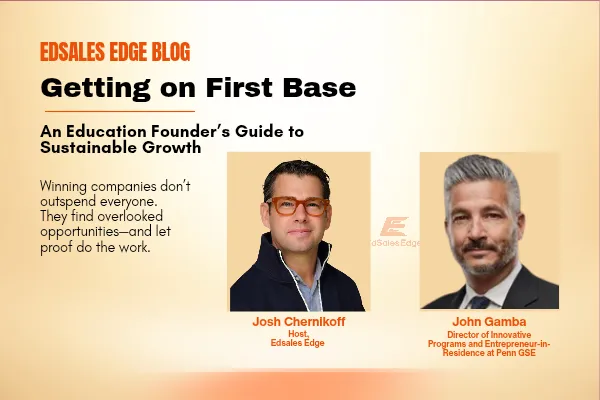
Getting on First Base: An Education Founder’s Guide to Sustainable Growth
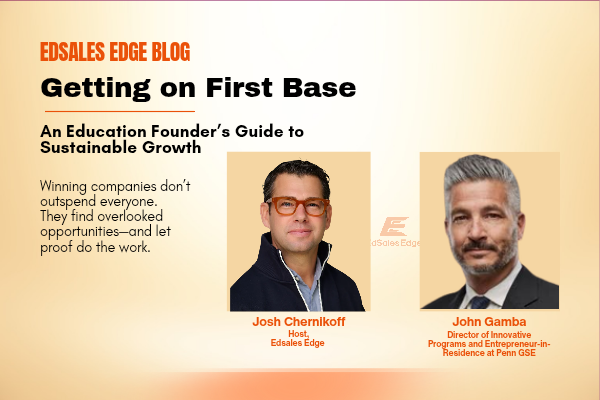
Most education founders think growth comes from landing the biggest district.
The massive logo. The giant contract. The flashy announcement. The “game-changing” deal.
And for a while, chasing those opportunities feels productive.
Big meetings happen. Conference conversations feel exciting. The pipeline looks active.
But underneath all that activity, many founders quietly feel the same thing:
Nothing is actually compounding.
That’s the deeper conversation Josh Chernikoff and John Gamba explore in this live episode of EdSales Edge.
Recorded just 17 days after Josh’s unexpected triple bypass surgery, the episode becomes much bigger than sales strategy. It becomes a conversation about entrepreneurship, recovery, pressure, resilience, and what sustainable growth actually looks like.
Joined by John, Entrepreneur-in-Residence at Penn GSE—recording on his birthday—the two break down Moneyball by Michael Lewis (and the film it inspired) and why its core lesson matters so deeply for education founders.
Because the companies that win rarely win by outspending everyone.
They win by building proof.
The Real Problem: Founders Chase Visibility Before Validation
One of the biggest mistakes early-stage education companies make is assuming momentum comes from looking bigger.
So founders chase:
giant districts
national visibility
conference hype
vanity metrics
“big opportunities”
And while those things may look impressive externally, they often create long sales cycles, unclear implementation paths, and conversations that never fully turn into traction.
That’s the trap.
Because activity is not the same thing as momentum.
And excitement is not the same thing as proof.
Why Smaller Districts Often Create Bigger Momentum
One of the strongest ideas in the episode is that smaller districts are frequently undervalued by founders.
Not because they generate the biggest contracts.
But because they generate the fastest learning.
Smaller districts often provide:
quicker decisions
direct access to leadership
stronger feedback loops
faster implementation
closer collaboration
clearer proof of effectiveness
And that proof matters more than most founders realize.
Because early growth is rarely about scale first.
It’s about evidence.
Evidence that the solution works. Evidence that buyers trust it. Evidence that implementation succeeds. Evidence that outcomes can repeat.
That’s what creates real momentum.
The “Get on First Base” Philosophy
At one point in the episode, John references his favorite line from Moneyball:
“We pay you to get on first, not to get thrown out at second.”
That line captures the entire philosophy behind sustainable growth.
Too many founders are chasing massive wins before they’ve proven they can consistently create small ones.
They want the giant district before proving implementation. They want scale before repeatability. They want visibility before validation.
But sustainable businesses are usually built differently.
They stack wins. They shorten the distance between conversation and implementation. They build systems that create repeatable outcomes.
And over time, that proof compounds.
Why Founders Confuse Activity With Traction
This is another subtle but important distinction in the episode.
A full calendar can feel like momentum. Conference conversations can feel like traction. A crowded pipeline can feel like growth.
But none of those things matter if implementation never happens.
That’s why John emphasizes compressing “contact-to-contract.”
Because momentum comes from movement. Not conversation.
The founders who grow sustainably aren’t always the loudest. They’re often the clearest.
Clear on:
the problem they solve
who they solve it for
how implementation works
what success looks like
how to repeat the process
That clarity is what allows growth to compound.
Why Proof Beats Hype
One of the biggest lessons underneath this entire conversation is that proof creates leverage.
Not hype. Not impressions. Not attention.
Proof.
Proof creates referrals. Proof creates confidence. Proof creates renewals. Proof creates expansion.
And most importantly: Proof reduces risk.
That matters enormously in education sales, where buyers are constantly evaluating whether a solution will actually work inside their environment.
Founders often think they need bigger opportunities.
But many actually need stronger proof.
The Hidden Theme: Staying in the Game
What makes this episode especially powerful is that it’s not just about business strategy.
It’s also about endurance.
Josh returning just 17 days after major surgery changes the emotional tone of the conversation. The discussion becomes a reminder that entrepreneurship is not just about scaling companies.
It’s about sustaining yourself long enough to keep building.
Sometimes winning looks dramatic. But often it looks much quieter:
showing up
recovering
learning
improving
staying consistent
continuing to build
That’s what sustainable growth really is.
Not one giant breakthrough.
But small wins that compound over time.
The Real Question This Episode Leaves You With
Most founders ask: “How do we grow faster?”
But this episode pushes a better question:
Have we actually built enough proof yet?
Because sustainable growth doesn’t usually come from chasing bigger opportunities.
It comes from building repeatable evidence that what you do actually works.
And once that proof exists, momentum becomes much easier to sustain.
The Bottom Line
The best education founders don’t win because they swing harder.
They win because they consistently get on base.
They find overlooked opportunities. They build proof. They create repeatable outcomes. And they let momentum compound over time.
Because sustainable growth isn’t built on hype.
It’s built on evidence.
🎧 Listen to the full episode
[Apple Podcasts] | [Spotify]
Stop chasing home runs.
Start building proof.