
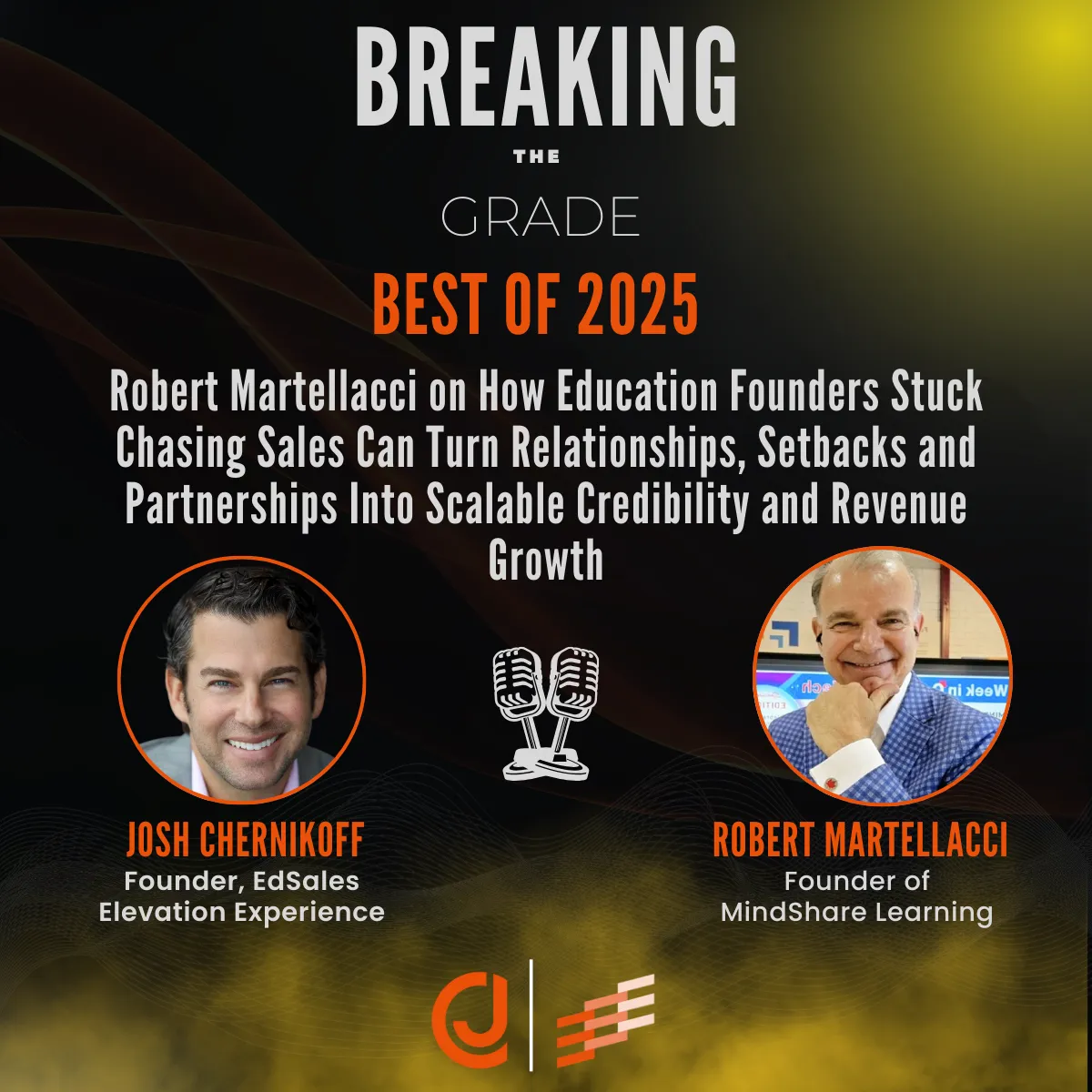
🎙️ Best of 2025: Robert Martellacci on How Education Founders Stuck Chasing Sales Can Turn Relationships, Setbacks, and Partnerships Into Scalable Credibility and Revenue Growth 🎙️
Hey Breakers,
Every founder I talk to right now is hustling, not lazily, not casually, but aggressively.
You’re out there pushing, showing up, shaking hands… but the numbers don’t move.
The right people aren’t calling back.
Your momentum stalls.
Opportunities crumble before they turn into contracts.
It’s not for lack of effort.
Sometimes It's ecosystem credibility, the engine that turns relationships into trust, and trust into sales. Without it, every conference, every handshake, every pitch is just noise. And every month you operate without it? That’s $50K–$250K in partnerships, pilots, and contracts slipping into someone else’s pipeline.
In one of the most practical LinkedIn Lives of 2025, Robert Martellacci, founder of Mindshare Learning Media and architect of Canada’s EdTech AI Summit, joined me to break down the real reasons founders stall… and how to turn relationships, community buy-in, and strategic positioning into predictable revenue.
Visible in the Ecosystem… but Not Trusted
A lot of founders think attending events or having “connections” equals revenue.
It doesn’t.
You can meet district leaders, DM investors, join panels, show up at summits… and still walk away with no follow-up calls, no partnerships, and no contracts.
Visibility ≠ adoption.
Visibility ≠ trust.
Visibility ≠ revenue.
As Robert put it, credibility in education isn’t built overnight, it’s earned through consistency, relationships, and genuine contribution to the ecosystem.
If educators don’t trust your intent…
If district leaders don’t believe your product solves a real problem…
If investors don’t see traction or buy-in…
They won’t invest their time, attention, or budget, no matter how innovative your product is.
Every handshake that doesn’t lead to a second meeting is a missed contract.
Every summit attended without follow-up trust is a lost opportunity.
Build Ecosystem Credibility First
Innovation without credibility is like launching a classroom with no teachers, there’s structure, but no impact.
Before you pitch again, ask:
Does the ecosystem trust me enough to adopt what I’m offering?
Credibility isn’t built through marketing.
It’s built through:
Relationships educators vouch for
Problems you’ve actually solved
Case studies rooted in real classrooms
Partnerships that validate your value
Robert’s experience launching Kevin O’Leary’s school division and helping shape the Canadian EdTech Summit proves one thing:
Founders who build community trust first scale faster, close more deals, and experience fewer stalled pipelines.
When teachers, principals, investors, and partners advocate for you — that’s when adoption accelerates.
Relationships → Pipeline
Every meaningful relationship in EdTech is a seed.
Teachers, superintendents, investors, policy makers, summit organizers, the people who actually influence adoption and budgets, move slowly… until they don’t.
A coffee conversation becomes a campus tour.
A campus tour becomes a pilot.
A pilot becomes a $25K–$100K contract.
Robert’s seen it for 25+ years: trusted relationships consistently outrank cold outreach, ads, or clever pitches.
But these aren’t shallow, transactional relationships.
They’re built on:
showing up at the right events
giving before asking
understanding local context
listening more than selling
following up with intention
Pipeline is not a spreadsheet.
Pipeline is a network — one that grows through trust.
Setbacks Are Not Failures, They’re Strategy
“You learn more from losing than winning.”
Whether Robert is talking about the hockey rink or a stalled deal, the principle is the same.
Most founders treat setbacks as dead ends.
Robert treats them as strategy refinements.
A “no” becomes insight.
A failed pilot becomes a pivot.
A delayed partnership becomes a better approach.
This mindset is why founders who reflect, instead of react, close more deals over time.
Your best strategic moves will come from understanding:
Why a district didn’t move forward
Why a partner disengaged
Why an investor hesitated
Why a demo didn’t convert
Setbacks are not indicators of failure, they are indicators of where your strategy needs sharpening.
Summits, Panels, and Ecosystem Rooms That Actually Matter
Not all events create opportunity.
Some waste your time.
Some drain your energy.
Some give you great photos but zero pipeline.
Robert breaks down a simple truth:
It’s not the event, it’s the room.
Events like the Canadian EdTech Summit aren’t just gatherings, they’re growth accelerators.
They’re where founders meet superintendents with budgets, innovators with partnerships, investors looking for edtech solutions and policy makers shaping adoption
When you show up in the right rooms:
your credibility grows
your network deepens
your brand enters conversations without you
your deals move faster
A single hallway conversation can shift your entire year.
Community Buy-In = Revenue Acceleration
If the people using your product don’t believe in it…
If the teachers don’t advocate for it…
If the students don’t engage with it…
Nothing else matters.
Community buy-in is the difference between:
→ A pilot that fizzles
→ A pilot that becomes a districtwide rollout
Robert has seen schools adopt tools because teachers loved them, and reject tools that had great pitch decks but no classroom resonance.
Your users, teachers, students, administrators, aren’t passive.
They’re your most credible champions.
Or your biggest blockers.
When they trust you, adoption spreads faster than any marketing plan.
Innovation Is Not Enough, It Must Translate Into Action
Founders love product.
Educators love solutions.
Robert’s story of the Mindshare Workspace Pod shows how innovation becomes revenue:
✅ It solves a real problem
✅ It fits into existing workflows
✅ It’s adopted by communities
✅ It opens new markets (schools, co-working spaces, partners)
Innovation that isn’t used is just an idea.
Innovation that’s adopted is a business.
The education founders who win aren’t the most inventive.
They’re the ones who turn ideas into impact, and impact into sales.
Shift From Pitching to Partnering
Stop chasing deals.
Stop chasing attention.
Stop chasing “visibility.”
Start building credibility.
Start building relationships.
Start building community momentum.
Buyers don’t want pitches, they want partners they trust.
Every meeting, every summit, every connection is a credibility lesson.
Are you building trust?
Are you creating value?
Are you becoming someone the ecosystem champions?
Or are your efforts scattered, loud, visible, but not trusted?
Founders who prioritize relationships, credibility, and community buy-in grow pipelines that don’t dry up. They build networks that advocate for them. They close deals faster and with more predictability.
📩 Listen to the full episode → Apple | Spotify
Because education founders who lead with credibility, relationships, and community don’t chase growth, growth finds them.
— Josh
#BreakingTheGrade #EdSales #RobertMartellacci #EdTechSummit #CredibilityConverts #EducationFounders #LeadGeneration #EcosystemTrust #FounderMindset #PartnershipSelling #CommunityDrivenGrowth