
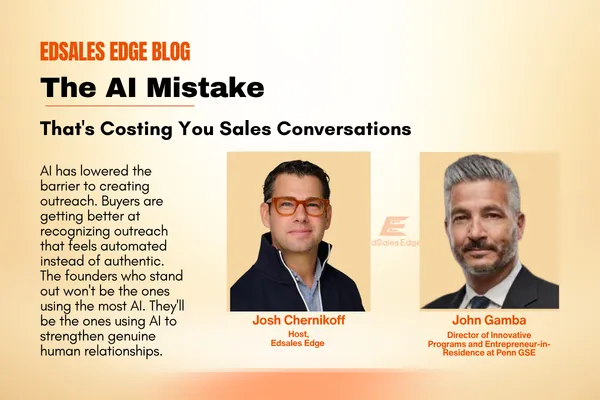
The AI Mistake That's Costing You Sales Conversations

AI is incredible.
It can research school districts, summarize strategic plans, identify buyers, draft emails, write LinkedIn messages, prepare sales questions, and analyze sales calls.
Education founders can now do in minutes what used to take hours.
So here's the question:
If outreach is easier than it has ever been, why are so many education founders still struggling to get replies?
That's the question at the center of this episode of EdSales Edge, where Josh Chernikoff, founder of the EdSales Revenue Machine, and John Gamba, Entrepreneur-in-Residence at Penn GSE, explore how education companies and teacherpreneurs can use AI to generate more leads without sounding like AI.
The problem isn't that AI isn't powerful enough.
It's that AI has made it easier for everyone to do the same things.
Everyone can research a district.
Everyone can personalize an email.
Everyone can create a LinkedIn message.
Everyone can build a follow-up sequence.
And when everyone has access to the same tools, more outreach doesn't automatically mean more responses.
In fact, some buyers are becoming better at recognizing when a message feels generated instead of genuinely thoughtful.
That's where the conversation turns to a lesson from Lionel Messi.
AI Is the Equipment. You're Still the Player.
Messi has elite cleats, world-class coaches, video analysis, performance data, nutrition experts, and technology designed to help him perform at the highest level.
All of those things make him better prepared.
But none of them score the goal.
Messi still has to read the field.
He still has to make decisions.
He still has to recognize opportunities before anyone else.
That's exactly how founders should think about AI.
AI should be your equipment—not the player.
It should make you better.
It should help you prepare.
It should give you information faster.
But it should never replace your judgment.
The founder still has to recognize the opportunity, make the decision, and build the relationship.
AI Has Made Outreach Easier. That's Part of the Problem.
There was a time when researching a school district, identifying the right decision-maker, understanding a district's priorities, and writing a thoughtful outreach message required significant time.
Now, AI can help with all of it.
That's a huge advantage.
But it also creates a new problem.
When everyone has access to similar tools, more outreach starts to look and sound the same.
A founder can generate a technically personalized email in seconds. They can reference a district initiative, mention a strategic priority, and create a follow-up sequence that looks customized.
But technically personalized doesn't necessarily mean emotionally memorable.
The message may be grammatically perfect. It may contain the right details. It may even be personalized to the recipient.
And still, the buyer may feel nothing.
That's because personalization isn't just about inserting someone's name or mentioning something you found on their website.
It's about demonstrating that you understand their reality.
That's a much harder problem to solve.
Don't Automate Before You Understand the Foundation
One of the biggest mistakes founders can make is starting with the technology.
They ask:
What AI platform should I use?
What prompt should I write?
How can I automate more of my outreach?
But Josh argues that those aren't the first questions founders should be asking.
Before choosing the platform or perfecting the prompt, founders need to understand the fundamentals of their business:
Who is your perfect client?
Why should they believe you?
What credibility do you have?
Is your offer clear?
Do you understand the problem you're actually solving?
If those pieces aren't clear, AI won't fix them.
The best prompt in the world can't rescue an unclear offer. The most sophisticated automation can't compensate for weak positioning.
AI can amplify what already exists.
If the foundation is strong, that can be incredibly powerful.
If the foundation is weak, AI may simply help you produce more of the wrong thing—faster.
Josh returns to the Messi analogy to explain the point.
Messi doesn't put on his cleats and then ask where he's supposed to play.
The match comes first.
The equipment serves the mission.
The same principle applies to AI.
Your sales strategy comes first.
Your understanding of the buyer comes first.
Your offer comes first.
Then AI becomes the equipment that helps you execute better.
Don't Just Use AI for One Task. Integrate It.
John takes the conversation in another direction.
He isn't against automation. In fact, he sees enormous potential in integrating AI throughout the sales process.
Imagine conducting a sales call and having AI analyze the conversation afterward.
It could identify important insights, surface the prospect's priorities, help prepare a proposal, and organize the information needed for follow-up.
That's where John sees tremendous value.
The difference is what happens next.
John doesn't believe the process should end with AI automatically sending everything out.
The human should still review it.
The founder should still check the details.
The founder should still catch potential hallucinations or inaccuracies.
And the founder should still make the final decision about what gets sent.
AI can do much of the hard work.
The human should still trigger the relationship.
The goal isn't full automation.
It's intelligent assistance.
Automate the Work. Don't Automate the Relationship.
This is where Josh and John agree most strongly.
AI can research.
AI can organize.
AI can summarize.
AI can analyze sales calls.
AI can prepare briefs and proposals.
AI can repurpose content.
All of that can save founders enormous amounts of time.
But relationship-building is different.
John describes AI's role as helping founders handle more of the quantitative work while allowing humans to focus on the qualitative elements.
AI can increase the quantity of outreach.
The founder still needs to improve the quality of the connection.
And there isn't necessarily one correct balance.
John may prefer to identify the six most probable prospects and focus deeply on those relationships.
Josh may prefer a broader approach and send more messages.
Both approaches can work.
The point isn't that one strategy is universally correct.
The point is that AI can support either strategy.
What cannot be skipped is understanding who you're targeting and why they would want what you're offering.
The Signature Solution Still Comes First
No matter how you use AI, there's a process that can't be skipped.
You have to know your target audience.
You have to understand why they need your solution.
You have to know why they would choose you.
That's the foundation of the Signature Solution.
AI can help you execute the strategy.
It can't decide what your business should fundamentally stand for.
That's still your job.
John gives an example of what this might look like in practice.
Imagine you have a raving-fan client whose district has seen strong results from your solution.
AI could research other school districts within a certain geographic area.
It could identify districts working on similar priorities.
It could analyze strategic plans and find schools focused on something like the Science of Reading.
It could then help identify the districts most likely to benefit from the type of results your existing client has achieved.
That's powerful.
The AI has done hours of research and analysis.
But it hasn't built the relationship.
It has simply put the founder in a much better position to start one.
Personalization Starts With Curiosity
This may be one of the most important distinctions in the entire conversation.
AI can help you discover information about a buyer.
But what you do with that information matters.
Josh shares an example developed with his AI, Max.
Instead of telling a superintendent:
"Your district is clearly struggling with teacher retention."
The better approach might be:
"I noticed teacher retention showed up several times in your strategic plan. How is that challenge showing up for your team today?"
The first statement is a conclusion.
The second is curiosity.
That's the difference.
The first assumes you know the buyer's problem.
The second invites the buyer to tell you about it.
And that creates a conversation.
Founders don't build relationships by proving how much research they've done.
They build relationships by using that research to ask better questions.
AI can help you find the signal.
You still have to decide what to do with it.
Don't Let AI Turn Your Outreach Into AI Slop
As AI becomes more common, buyers are getting better at spotting it.
Superintendents and education decision-makers are receiving more messages than ever.
Many are polished.
Many are personalized.
Many are written with the same tools.
And increasingly, buyers can feel the difference between a message that was generated and one that was genuinely considered.
That's why the goal shouldn't be to use AI to send more messages simply because you can.
The goal should be to use AI to make your messages more deserving of a response.
Instead of asking:
"How many emails can I send this week?"
Ask:
"How can I use AI to make this one email more relevant?"
Instead of:
"How can I automate every follow-up?"
Ask:
"How can I make sure my follow-up adds value?"
Instead of:
"How can AI talk to more prospects for me?"
Ask:
"How can AI help me understand the people I want to talk to?"
The technology may be similar.
The results won't be.
What If You Haven't Started Using AI Yet?
Not every founder is already building sophisticated AI workflows.
John has a recommendation for those who are just getting started.
Open a tool like Gemini, Claude, or Copilot.
Tell it about yourself.
Explain what your company does.
Describe your ideal client.
Then ask it to draft a prospective email.
But don't simply copy and paste what it gives you.
Ask the AI to critique the email.
Ask what it thinks about the tone.
Ask how it could be improved.
Ask it to write another version.
Then refine it again.
The value isn't necessarily in getting AI to write the perfect email for you.
It's in using AI as a conversation partner—a second perspective that helps you see your message differently.
Rarely will AI immediately write something that sounds exactly like you.
That's okay.
Use AI to provide perspective and context.
Then bring your own voice back into the conversation.
The Real Advantage Isn't More AI. It's Better Judgment.
AI has changed the mechanics of education sales.
Founders can now research faster.
Prepare faster.
Analyze faster.
Write faster.
Follow up faster.
But speed isn't the same thing as effectiveness.
The founders who win won't necessarily be the ones who automate the most.
They'll be the ones who understand what should be automated—and what should never be handed over completely.
Use AI to do the research.
Use it to organize information.
Use it to identify patterns.
Use it to prepare.
Use it to make you faster and more informed.
But when it comes to curiosity, judgment, trust, and relationships, step back in.
Because AI can help you find the right person.
It can help you understand the right problem.
It can help you prepare the right message.
But ultimately, you are the one who has to start the conversation.
And you are the one who has to build the relationship.
The Bottom Line
The biggest AI mistake education founders can make isn't using AI too much.
It's using AI without understanding what it's actually there to do.
AI should be your equipment.
Not your player.
It should help you research more intelligently, prepare more effectively, and communicate more clearly.
But it shouldn't replace the human judgment that makes your outreach worth responding to.
Because the future of education sales isn't about choosing between technology and relationships.
It's about using technology to become better at building them.
The question isn't whether AI is helping you send more messages.
The better question is:
Is AI helping you build more relationships?
🎧 Listen to the full conversation:
[Apple Podcasts] | [Spotify]
And if you're ready to turn more conversations into paying clients, text "90 DAYS" to 771-333-4233 to get the 90-Day Founder Challenge—a practical framework for your next 90 days.
Teacher-founders: limited 1:1 planning sessions available.
The best use of AI isn't to replace the human connection. It's to give you more time, insight, and clarity to create it.