
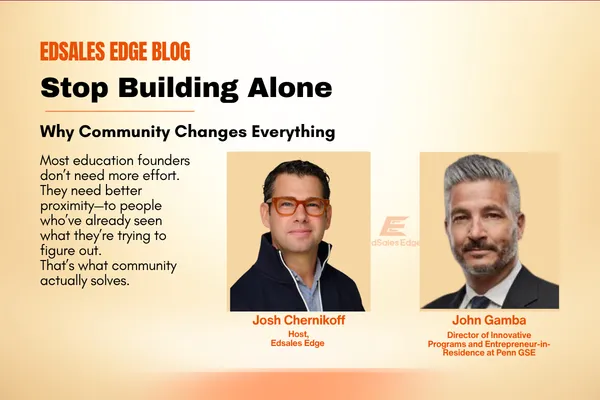
Stop Building Alone: Why Community Changes Everything
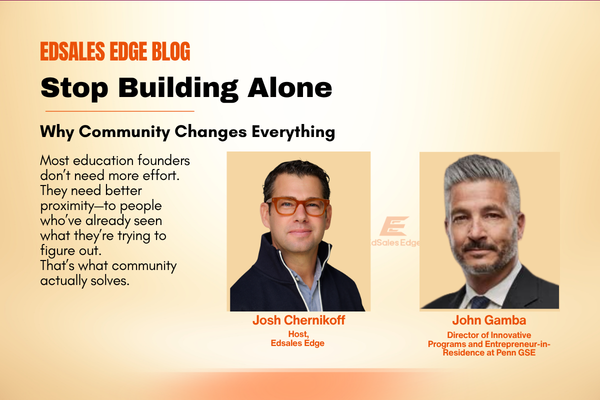
Most education founders don't have a networking problem.
They have a carrying-too-much problem.
At first, that's normal.
You start the company.
You make the decisions.
You sell the product.
You solve the problems.
You figure things out.
That level of ownership is often what gets a business off the ground.
But eventually something changes.
The same independence that helped you build the company starts making growth harder.
Every decision flows through you.
Every challenge lands on your desk.
Every difficult conversation waits for your attention.
The business grows, but the weight grows with it.
That's the challenge Josh Chernikoff, founder of the EdSales Revenue Machine, and John Gamba, Entrepreneur-in-Residence at Penn GSE, explore in this episode of EdSales Edge.
Because for many education founders, the problem isn't effort.
It's trying to carry a business that has become too large for one person's perspective.m.
The Hidden Cost of Building Alone
Most founders don't wake up and decide to isolate themselves.
It happens gradually.
You get busy.
The calendar fills up.
Customer issues need attention.
Sales conversations need follow-up.
Product decisions need answers.
And before long, you're spending most of your time reacting instead of learning.
The dangerous part isn't the workload.
It's the narrowing of perspective.
When founders build in isolation, they lose access to one of the most valuable business assets available to them:
Other people's experience.
Problems feel bigger when you're seeing them for the first time.
They feel very different when you're talking to someone who's already solved them.
That's why the right conversation can save months of frustration.
Not because it eliminates the challenge.
Because it helps you see the challenge differently.
Why Community Matters More Than Most Founders Realize
Many people hear the word "community" and immediately think networking.
Events.
Introductions.
LinkedIn connections.
More people.
That's not what we're talking about.
Real community creates something much more valuable.
Perspective.
Accountability.
Pattern recognition.
The ability to learn from lessons you didn't personally have to pay for.
The best founder communities don't exist to motivate people.
They exist to help people think better.
Because growth isn't always about finding new answers.
Sometimes it's about seeing answers that were already there.
The Lesson From Theo of Golden
The Lesson From Theo of Golden
One of the most memorable moments in Josh and John's conversation centers around a concept from Theo of Golden by Allen Levi.
The book introduces the idea of a murmuration.
A flock of birds moving together.
No single bird leading. No single bird carrying the entire load. Just shared movement, shared awareness, and shared direction.
John uses the idea as a lens for thinking about founder growth.
Because many entrepreneurs have been taught that leadership means carrying everything themselves.
Making every decision. Solving every problem. Holding every responsibility.
But that's rarely how lasting growth happens.
The strongest businesses aren't built by founders who carry the most weight.
They're built by founders who create environments where people learn, contribute, and move forward together.
The Difference Between Independence and Isolation
Independence is valuable.
Isolation is expensive.
There's a difference.
Independent founders take ownership.
Isolated founders try to solve everything themselves.
One creates progress.
The other creates exhaustion.
That's especially true in education.
Education sales cycles are longer.
Stakeholders are more complex.
Decision-making takes time.
The challenges are rarely simple.
Trying to navigate all of that alone doesn't make you stronger.
It usually makes growth slower.
The Real Question
Most founders ask:
"How do I grow faster?"
But this conversation suggests a different question:
What am I still trying to carry by myself?
Because growth doesn't always come from working harder.
Sometimes it comes from getting closer to the right people.
The people who challenge your thinking.
The people who expand your perspective.
The people who help you see around corners.
The people who remind you that building a company was never supposed to be a solo sport.
The Bottom Line
Many founders believe community is support.
The best founders understand it's infrastructure.
Not because it removes hard problems.
Because it helps you navigate them with better perspective, better relationships, and better decisions.
You can build alone.
But eventually, growth gets easier when you stop trying to.
🎧 Listen to the full episode
[Apple Podcasts] | [Spotify]
Stop carrying everything yourself.
Start building with people who make the journey lighter.