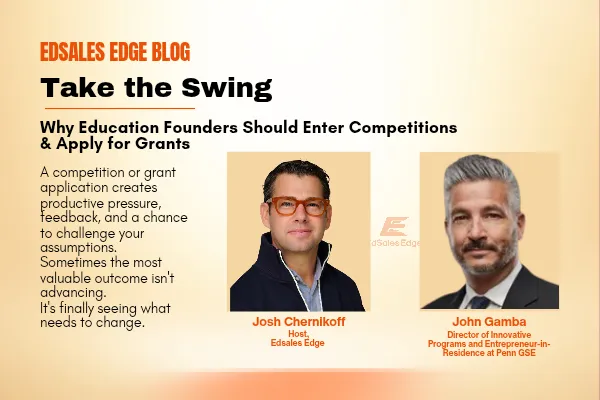
Take the Swing: Why Education Founders Should Enter Competitions & Apply for Grants
You find the competition.
You read through the application.
You look at the previous winners.
Then you tell yourself:
“We're not ready.”
Maybe you need more traction.
Maybe the product still needs work.
Maybe your evidence isn't strong enough.
Maybe the business model isn't as clear as it should be.
So you close the tab and decide you'll apply next year.
But what if being “not ready” is exactly why you should apply?
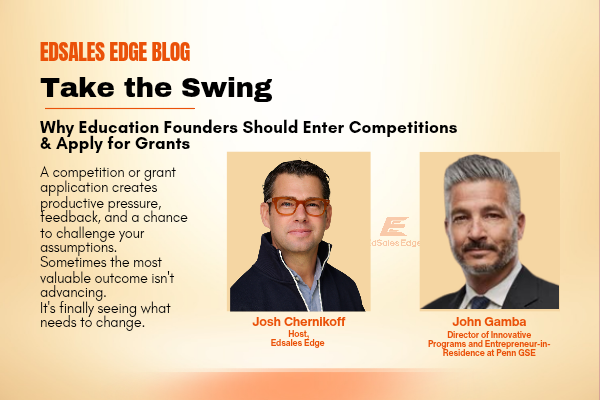
That question was at the center of a recent episode of EdSales Edge, where Josh Chernikoff, founder of the EdSales Revenue Machine, and John Gamba, Entrepreneur-in-Residence at Penn GSE, explored why education founders shouldn't treat competitions and grants as opportunities reserved for companies that already have everything figured out.
Sometimes the application itself is the opportunity.
The Application Will Expose What You're Avoiding
Most education founders know their businesses extremely well.
That's part of the problem.
When you spend every day building the product, talking to customers, refining the offer, and solving problems, it becomes harder to see the gaps that are obvious to someone on the outside.
A competition application creates distance.
Suddenly, you have to explain the business to someone who doesn't already understand it.
Who buys this?
What problem are you solving?
Why does that problem matter?
What makes your solution different?
What evidence shows that it works?
How big is the opportunity?
How will the business grow?
Those questions sound simple until you have to answer them clearly.
And if you struggle, that's useful information.
The application hasn't exposed why your business shouldn't win.
It may have exposed what your business needs to work on next.
Clarity Under Pressure Is a Business Skill
Competitions often force founders to explain complicated ideas in very little space.
You may have 1,000 words.
Sometimes much less.
You can't explain the entire history of the company.
You can't include every feature.
You can't give the judges a 20-minute walkthrough before they understand what you do.
You have to make choices.
What matters most?
What does the buyer care about?
What makes this solution different?
What proof belongs in the story?
That pressure is valuable because the same challenge appears everywhere else in the business.
A superintendent doesn't want a 30-minute explanation before understanding the value.
An investor doesn't want to search through 40 slides to find the business model.
A potential partner shouldn't have to decode your website to understand who you serve.
The ability to explain your business clearly is not just a competition skill.
It's a sales skill.
It's a fundraising skill.
It's a leadership skill.
“We're Not Ready” Can Become a Hiding Place
There are legitimate reasons not to apply for something.
The opportunity may not fit your market.
The eligibility requirements may not fit your company.
The time commitment may be unreasonable.
But “we're not ready” deserves a second look.
Not ready for what?
Not ready to win?
Not ready to answer the questions?
Not ready to receive feedback?
Not ready to discover that something in the business isn't as strong as you thought?
There is a difference between preparation and avoidance.
Waiting until everything feels perfect can become a very sophisticated way of avoiding being tested.
And education founders can wait a long time.
There will always be another product update.
Another case study you want to collect.
Another pilot you want to finish.
Another customer you want to land.
Another reason to wait.
At some point, you have to take the swing.
Not Winning Doesn't Mean You Lost
Entrepreneurs tend to treat competitions like championships.
Win, and it was worth it.
Lose, and the effort feels wasted.
But businesses don't develop that way.
A founder might apply one year and get rejected.
The next year, the application is stronger.
The positioning is clearer.
The evidence is better.
The team has grown.
The founder applies again.
Maybe they make the semifinals.
Maybe they don't.
Then they improve again.
Eventually, they may become a finalist.
They may even win.
That doesn't mean the earlier attempts were failures.
They were reps.
The application created a reason to examine the business, sharpen the story, and improve the next attempt.
That's what progress often looks like.
Not one perfect swing.
A series of better ones.
Feedback From the Outside Hits Differently
Your team knows what you're trying to build.
Your customers may already understand the product.
Your advisors may have followed the company for years.
Competition judges haven't.
That's what makes their perspective valuable.
Imagine hearing:
“I still don't understand who pays for this.”
Or:
“I understand the product, but I don't understand why a district needs it now.”
Or:
“I don't see enough evidence that this produces the outcome you're promising.”
Those comments can be frustrating.
They can also save you months of selling the wrong story.
Because if an experienced evaluator can't understand who buys the product, there's a good chance some prospects can't either.
If your differentiation isn't obvious in the application, it may not be obvious in a sales conversation.
If your evidence feels weak to judges, it may feel weak to a school leader responsible for defending the purchase.
Good feedback doesn't simply tell you how to improve the application.
It tells you where the business story may be breaking down.
The Prize Isn't Always the Best Part
Funding matters.
Exposure matters.
Winning matters.
But competitions can create value long before someone announces a winner.
You may meet another founder who becomes a partner.
You may find an advisor who helps you solve a problem you've been stuck on.
You may discover a completely different way to explain your solution.
You may hear a question from a judge that changes your positioning.
You may finally sit down with your team and define things you've been talking around for months.
That matters.
Especially for founders who spend most of their time inside the business.
The right competition can become a forcing function.
It gives you a deadline.
It gives you criteria.
It gives you outside evaluation.
And it gives you a reason to make decisions you've been postponing.
Grants Are Competitions Too
You don't need a stage, microphone, or panel of judges for this principle to apply.
Grant applications create many of the same pressures.
Programs such as SBIR and IES funding opportunities require founders to make a rigorous case for why their work deserves support.
What's the problem?
What's innovative about the solution?
What evidence supports the approach?
What will the funding allow you to test or build?
Why is your team capable of doing it?
And because many grants provide non-dilutive funding, the potential upside can be substantial.
But even when the application isn't successful, the work can still be useful.
The research can support your sales materials.
The evidence can strengthen your credibility.
The market explanation can sharpen your positioning.
The language can become part of another application.
The questions can reveal gaps in your strategy.
The work doesn't suddenly become worthless because someone else received the funding.
Choose the Right Arena
That doesn't mean applying for everything.
A competition is only useful if it fits where the business is going.
Some opportunities offer funding.
Others offer mentorship.
Some create visibility.
Others provide access to buyers, investors, researchers, or other founders.
Programs such as the Milken-Penn GSE Education Business Plan Competition, SXSW EDU Launch, the GSV Cup, EdTech Week, and other education-focused competitions create different kinds of opportunities.
The same is true of grants.
The goal isn't to collect applications.
The goal is to choose opportunities that can move the business forward.
Before applying, ask:
What could we gain even if we don't win?
If the only valuable outcome is the prize, the opportunity may not be worth your time.
But if the process can create clarity, feedback, connections, credibility, or a stronger business, the calculation changes.
Pay Attention to the Questions You Hate
There's an easy way to turn an application into a useful business exercise.
Notice which questions make you uncomfortable.
Maybe it's:
Who is your primary buyer?
Maybe it's:
What makes your solution meaningfully different?
Maybe it's:
What evidence proves this works?
Maybe it's:
How big is the actual market?
Maybe it's:
How does this scale beyond the founder?
Don't rush past those questions.
Spend more time there.
Because the hardest question on the application may be pointing directly at the weakest part of the business.
That doesn't mean you're not ready to enter.
It may mean you've just discovered what to improve.
Take the Swing
Find one competition, grant, accelerator, or funding opportunity that fits your business.
Read the criteria.
Study the questions.
Look at previous winners.
Then apply.
Prepare like you expect to win.
Build the strongest application you can.
Use the feedback.
Pay attention to where you struggle.
And if you don't advance, decide what the experience taught you before deciding whether it was worth it.
Because waiting until you feel completely ready may mean waiting forever.
The founders who improve aren't always the ones who avoid rejection.
They're often the ones willing to put the business in situations where its weaknesses become impossible to ignore.
Then they fix them.
And swing again.
Listen to the Full Conversation
Want to hear the full discussion about competitions, grants, the Milken-Penn GSE Education Business Plan Competition, SXSW EDU, the GSV Cup, EdTech Week, and why the application process itself can make your business stronger?
🎧 Listen to the full episode on Apple Podcasts and Spotify.
Ready for the Next Step?
If you're building an education business and want a clearer path to sustainable growth, text “90 DAYS” to 771-333-4233.
You'll receive the 90-Day Founder Challenge, a practical framework designed to help education founders create momentum over the next 90 days.
Teacher-founders: Limited 1:1 planning sessions are available.
Prepare like you plan to win.
Take the swing anyway.