
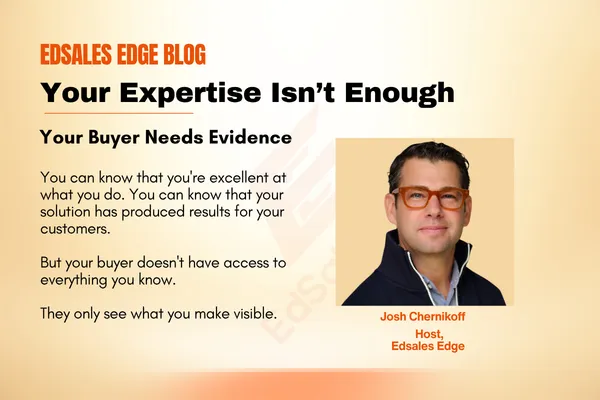
Your Expertise Isn't Enough. Your Buyer Needs Evidence
Your credibility walks into the room before you do.
Before you send the email.
Before you take the meeting.
Before you explain what you do.
Your buyer is already deciding whether you're someone they can trust.
And that decision isn't based only on how much you know.
You can know your market inside and out. You can have years of experience, impressive credentials, strong relationships, and real results.
And your buyer can still hesitate.
Why?
Because expertise you own isn't automatically credibility your buyer can see.
That's the idea at the center of this episode of EdSales Edge, where Josh Chernikoff, founder of the EdSales Revenue Machine, breaks down what makes an education founder credible in a buyer's eyes and why another credential may not be the answer.
Expertise and Credibility Are Not the Same Thing
This distinction matters.
You own your expertise.
Your buyer decides your credibility.
You can know that you're excellent at what you do. You can know that you've spent 20 years working inside schools. You can know that your solution has produced results for your customers.
But your buyer doesn't have access to everything you know.
They only see what you make visible.
That's why a founder can be highly experienced and still struggle to generate qualified leads.
The problem isn't necessarily a lack of expertise.
It may be a lack of evidence.
Your Buyer Can't Read Your Resume From Your Head
Imagine you're an education founder who spent two decades working inside schools.
That experience gives you valuable context.
You understand how school leaders think.
You understand the pressures they face.
You understand what happens when a promising initiative meets the reality of implementation.
But if none of that experience appears in your content, conversations, website, LinkedIn profile, customer stories, or other visible proof, your buyer can't use it to evaluate you.
You know the experience is there.
They don't.
That's the gap.
And when that gap exists, founders often respond by adding more credentials.
Another certification.
Another degree.
Another award.
Another line to the bio.
But the buyer may not need another credential.
They may need to see how you think.
The Perfect Client Needs to Experience How You Think
Your perfect client isn't just evaluating what you sell.
They're evaluating whether they believe you understand their world.
That's why stories can be more powerful than statements.
Compare these two claims:
"We understand district leaders."
That's a claim.
Now imagine a founder telling a story about working with a district leader who had strong support for a new initiative but couldn't get principals to implement it.
The founder explains what happened, what the leadership team initially assumed, what they discovered was actually getting in the way, and what they changed.
The buyer isn't simply being told:
"We understand district leaders."
They're thinking:
"Wow. They really understand district leaders."
That's the difference between claiming credibility and demonstrating it.
Three Kinds of Credibility
Josh breaks credibility down into three forms:
1. Lived Credibility
This comes from what you've actually experienced.
Maybe you've been a teacher.
Maybe you've led a school.
Maybe you've spent years working inside districts.
Maybe you've lived through the exact problem your customer is now trying to solve.
That experience matters.
But experience sitting inside your head doesn't generate leads.
You have to make it visible.
Tell the story.
Explain what you learned.
Show how that experience changed the way you approach the problem.
2. Proof Credibility
This is the evidence that shows your solution works.
Customer results.
Case studies.
Specific outcomes.
Before-and-after examples.
Stories of what changed because someone worked with you.
Don't just say:
"We help schools improve outcomes."
Show what happened.
What was the problem?
What did you do?
What changed?
What did the customer experience?
Specific evidence gives your buyer something concrete to evaluate.
3. Borrowed Credibility
This comes from the people and organizations that already have trust.
A respected customer.
A recognized partner.
A conference where you were invited to speak.
A trusted education leader who recommends your work.
A relationship with someone your buyer already respects.
You don't have to build every ounce of credibility from scratch.
Sometimes credibility transfers through trusted relationships.
But again, it only helps if the buyer can see it.
Visibility Multiplies What You've Already Earned
This is where visibility becomes important.
You might already have all three forms of credibility.
You may have lived experience.
You may have excellent customer results.
You may have respected relationships.
But if your buyer can't find evidence of those things, they can't factor them into their decision.
The problem isn't always:
"I need more credibility."
Sometimes it's:
"I need to make the credibility I've already earned visible."
That's a very different problem.
And it's usually a much more useful one to solve.
Stop Confusing Claims With Evidence
Founders are naturally good at explaining what they do.
They know their product.
They know their methodology.
They know their differentiators.
So their marketing often becomes a collection of claims.
"We understand schools."
"We're experts in student engagement."
"We help districts transform learning."
"We have decades of experience."
None of these statements are necessarily false.
But they're not particularly persuasive on their own.
Your buyer has heard claims before.
Evidence gives those claims weight.
Instead of telling a buyer you understand school leaders, show them a situation that demonstrates your understanding.
Instead of saying you have decades of experience, tell the story that only someone with those decades of experience could tell.
Instead of saying customers love your solution, show what changed for one of them.
Don't just tell buyers you're credible. Give them something that lets them conclude it for themselves.
Your Credibility Should Start Working Before You Do
Think about what happens before a sales meeting.
Your buyer may Google you.
They may look at your LinkedIn.
They may visit your website.
They may read something you've written.
They may look at your customers.
They may ask someone they trust about you.
All of that happens before you get to explain yourself.
That's why credibility isn't something you bring into the meeting.
Your credibility gets there first.
If the evidence is already visible, the conversation starts from a different place.
You're no longer spending the first 20 minutes trying to convince the buyer that you understand their problem.
They may already believe it.
Now you can have a better conversation about whether your solution is right for them.
Don't Add Another Credential. Add Another Piece of Evidence.
Before you spend another month looking for the next certification, ask whether you've actually made the credibility you already have visible.
Take one piece of experience.
Turn it into a story.
Take one customer result.
Turn it into a case study.
Take one trusted relationship.
Make the connection visible.
Take one thing you understand deeply about your buyer.
Teach it.
That's how you give your buyer evidence.
And evidence compounds.
The more useful proof your buyer can find, the less work you have to do convincing them that you know what you're talking about.
Try This With Your Own Business
Take 10 minutes and look at your public presence as if you were your perfect client.
Then answer these five questions:
1. What lived experience do I have that my buyer would value?
2. What results can I prove?
3. Which trusted relationships strengthen my credibility?
4. Where can my buyer actually see that evidence?
5. What credibility have I earned that I'm currently hiding?
Don't answer with what you could show.
Look at what is actually visible today.
That's the gap that matters.
The Bottom Line
Your expertise matters.
But expertise alone doesn't create trust.
Your buyer has to experience enough evidence to believe that your expertise is relevant to their problem and that you can help them solve it.
That's why another credential isn't always the answer.
Sometimes the credibility you're looking for is already there.
You just haven't made it visible.
Your buyer doesn't need another list of qualifications.
They need proof they can see for themselves.
And that's why your credibility walks into the room before you do.
Listen to the Full Conversation
Want to hear Josh break down the difference between expertise and credibility, the three kinds of credibility, and how education founders can make the proof they've already earned more visible?
🎧 Listen to the full episode on Apple Podcasts and Spotify.
Ready for the Next Step?
Take 10 minutes.
Google yourself. Open your LinkedIn profile. Open your website.
Pretend you're your perfect client.
Ask yourself:
"What do I find here that gives me a reason to trust this person?"
Then make one piece of evidence more visible.
If you want help turning your priorities into a focused plan, text "90 DAYS" to 771-333-4233 for the 90-Day Founder Challenge.
Teacher-founders: limited 1:1 planning sessions are also available.